Today Is the Oct. 15 Extension Deadline. Here's What It Means for Santa Fe's Self-Employed Filers
If you filed Form 4868 back in April, today is the day that extension runs out. For a W-2 employee that's a simple box to check off. For Santa Fe's gallery owners, lab contractors, and seasonal hospitality operators, the deadline tends to arrive with a bigger, messier balance attached, and a narrower set of good options for dealing with it.
What Today's Deadline Actually Covers
Form 4868 gave you six extra months to file your 2025 return. It never gave you six extra months to pay. If you owed money on April 15, that payment was due then, and interest has been accruing on the unpaid balance ever since, extension or not. Today's deadline is strictly about getting the paperwork in.
Missing it switches on the failure-to-file penalty: 5% of the unpaid tax for each month or partial month the return is late, up to a maximum of 25%. That's separate from the failure-to-pay penalty, which has already been running at 0.5% a month since April. When both apply in the same month, the IRS doesn't stack the full amount of each, it combines them into one 5% monthly charge, 4.5% for filing and 0.5% for paying. But the two penalties cap out separately, so the maximum combined hit still reaches 47.5% of what you owe. A reasonable-cause argument can get the failure-to-file piece waived. It doesn't touch the tax itself or the interest that's already built up.
Why This Deadline Lands Differently in Santa Fe
Santa Fe's economy runs on a mix that doesn't fit the standard withholding model. State government employment is a steady piece of it, but the area also carries a large population of self-employed gallery owners and working artists along Canyon Road, hospitality operators whose revenue swings hard with the tourist season around the Plaza and the Palace of the Governors, and independent contractors who do technical or consulting work tied to Los Alamos National Laboratory. None of that income comes with a withholding line, and a lot of it doesn't arrive in a clean, predictable form until well after April: consignment statements from a gallery, a 1099 from a lab subcontract, a grant payment that posts in the fall. That's exactly the group that tends to end up on extension in the first place, and the same group most exposed to the penalty math above, because their liability usually shows up as one lump sum rather than something withholding already chipped away at all year.
We see the same pattern play out across Offer in Compromise and installment agreement cases throughout northern New Mexico: a self-employed filer who did everything else right but hit October 15 with a balance several times larger than they expected, because nobody told them in April how much the final number would actually be.
The Audit Exposure That Shows Up After Filing
Self-employment income draws more scrutiny than W-2 wages because there's no third party reporting it to the IRS the way an employer does. For a working artist, that often comes down to proving the activity is a business and not a hobby. Under IRC Section 183, the IRS looks for a genuine profit motive before it will let a loss from that activity offset other income, and it weighs things like separate bookkeeping, a business plan, and a consistent effort to turn a profit. An artist who's treated the paperwork casually, mixing personal and studio expenses, skipping a dedicated account, can end up with the activity reclassified as a hobby and the related deductions disallowed.
The more common trigger is the CP2000 underreporter notice, generated by computer match when a 1099 or similar form doesn't line up with the return. A gallery commission, a grant disbursement, or a subcontract payment from a lab-adjacent firm can each set one off if the issuer's reporting and your return don't agree. It isn't a full audit, no agent shows up, but it does require a written response by the date on the notice. Ignore it and the IRS moves ahead and assesses the proposed change without your side of the story.
If You Filed Today but Still Can't Pay in Full
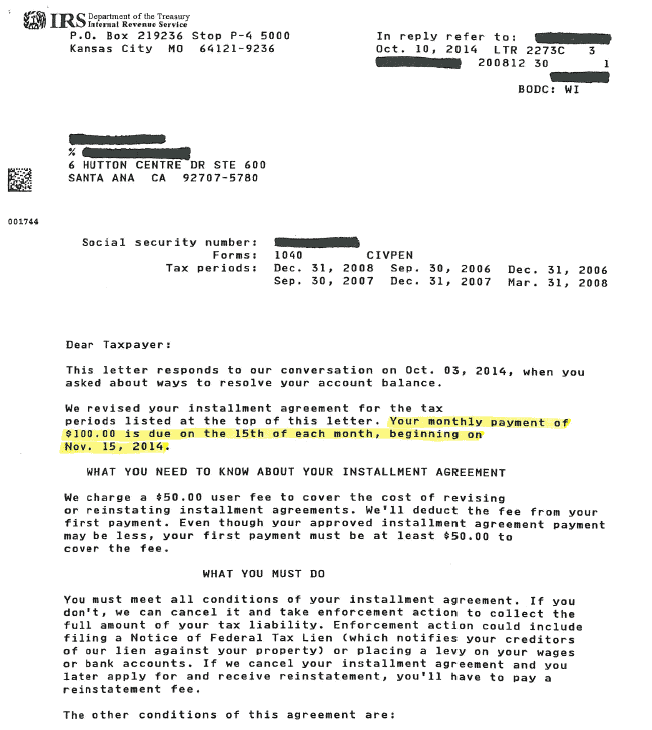
Get the return filed regardless. That alone stops the much larger failure-to-file penalty from accumulating further, even if the balance itself is still sitting there. From there, the options depend on the size of the gap. An installment agreement spreads the balance across monthly payments and drops the failure-to-pay rate to 0.25% a month while it's active, a meaningful reduction from the standard 0.5%. For a balance that's large relative to what you can realistically pay back given your income and assets, it's worth having your Reasonable Collection Potential reviewed for an Offer in Compromise. And where the late filing itself traces to something specific and documentable, a serious illness, a gallery that paid a consignment settlement months late, a layoff from a lab contract, penalty abatement for reasonable cause can remove the failure-to-file penalty even though the underlying tax and interest remain due.
Santa Fe's Second Layer: GRT and the State
Because Santa Fe is also home to the New Mexico Taxation and Revenue Department's own headquarters, state enforcement in the area is particularly active. New Mexico generally follows the federal extension for personal income tax, so a valid Form 4868 typically covers the state return as well. Gross receipts tax runs on an entirely different track. TRD collects it monthly, quarterly, or semiannually depending on volume, it's assessed on revenue rather than net profit, and it has nothing to do with today's income tax deadline. A self-employed filer juggling a federal extension and a GRT filing schedule on two separate calendars is a common way for one or the other to slip.
We work with self-employed filers throughout Santa Fe and the rest of northern New Mexico on exactly this kind of split federal-and-state exposure, and our team includes people who spent years on the collection side of the IRS before moving to the taxpayer's side of the table. If today's filing revealed a balance bigger than you can handle on your own, or a notice from an earlier year is still sitting unopened, that's worth a conversation now rather than letting the penalties above keep running.
Frequently Asked Questions
I filed Form 4868 back in April. Is today really my deadline?
Yes. Form 4868 bought you six extra months to file your 2025 return, and that window closes today, October 15. It never extended the deadline to pay. If you owed money, it was due April 15, and interest has been running on any unpaid balance since then regardless of the extension.
What happens if I don't get my return filed today?
The failure-to-file penalty turns on: 5% of the unpaid tax for each month or partial month the return is late, capped at 25%. It stacks with the failure-to-pay penalty already running at 0.5% a month, though the IRS combines the two into a single 5% monthly charge while both apply, rather than charging the full amount of each. File something today even if you can't pay in full. The penalty for not filing is steeper than the one for not paying.
I'm a Santa Fe artist and got a CP2000 notice. What does that mean?
A CP2000 means a 1099 or other third-party form the IRS received, a gallery commission statement or a grant payment, for example, didn't match what was on your return. It's generated by computer match, not a full audit, but it requires a written response by the date on the notice. Ignoring it lets the IRS assess the proposed change without your input.
Does New Mexico follow the same extension deadline?
New Mexico generally honors a federal filing extension for personal income tax, so a valid Form 4868 extension typically covers your state return too. Gross receipts tax is a separate matter entirely. It's collected by the Taxation and Revenue Department on its own monthly, quarterly, or semiannual schedule and isn't tied to the income tax extension at all.
I can't pay what I owe even though I filed on time. What now?
Filing today stops the much larger failure-to-file penalty from starting. For the balance itself, an installment agreement spreads payments over time and drops the failure-to-pay rate to 0.25% a month while it's in effect. Larger balances relative to your income and assets may qualify for an Offer in Compromise, and penalty relief is available where the late filing itself had a specific, documentable cause.
Get your free tax debt action plan.
15 minutes with our resolution team. A concrete plan, yours to keep. No obligation, no pressure.